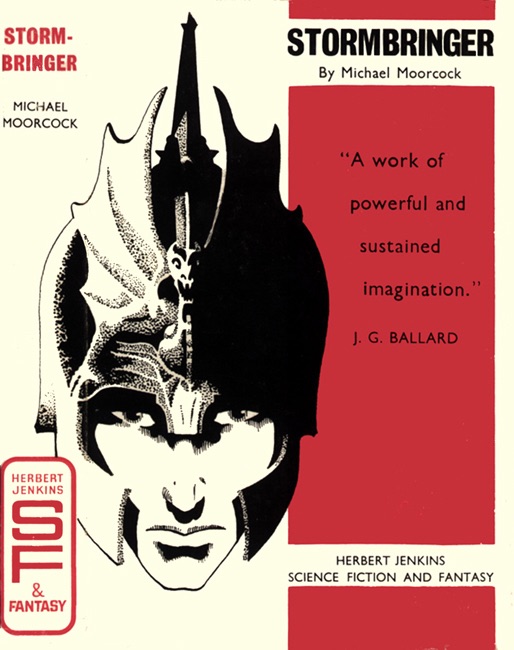
Moorcock’s multiverse is the first one that isn’t built like a strip mall of IP franchises. Before Marvel turned “infinite worlds” into an excuse to recycle plotlines forever, Moorcock treated parallel realities as a way to ask better questions. His multiverse isn’t rent-seeking; it’s curiosity-seeking. It doesn’t exist to justify more product—it exists to make you wonder what kind of person you’d be if the cosmic wheel spun one click to the left.
In the Eternal Champion cycle, the worlds proliferate because the ideas proliferate. Each universe is a philosophical experiment dressed up as pulp: What happens if chaos is noble? What if law is tyrannical? What if the hero is doomed by the structure of reality itself? Moorcock isn’t monetizing variations; he’s interrogating them. He’s using infinity the way a scientist uses a petri dish, not the way a studio uses a merchandising opportunity.
Marvel’s multiverse says, “Here’s another Spider-Man, wouldn’t you like to buy the Funko Pop?”
Moorcock’s says, “Here’s another version of you—are you sure you want to meet him?”
He was doing Borges with a battle-axe. The parallel worlds are there to unsettle you, to poke your metaphysics, to make you question fate, identity, morality, and the very idea of a “self.” It’s the multiverse as critique, not content pipeline.
While Tolkien was building a coherent, mythic past, Moorcock was building a dissident, recursive, and anti-mythic present. His multiverse is a tool for deconstruction. Elric isn’t just an anti-Conan; he’s a critique of the whole idea of the heroic barbarian. The Eternal Champion cycle dismantles the hero myth by showing it as a cosmic trap—a pattern of suffering enforced by blind cosmic forces. The multiverse exists to prove that no single heroic narrative is sufficient, or even valid.
Moorcock invented the first multiverse that wasn’t trying to extract anything from you—money, loyalty, nostalgia, brand affinity. It’s not a treadmill or a content vault. It’s a thought experiment that accidentally grew a pulse. His universes aren’t revenue streams; they’re philosophical test chambers where law and chaos get permuted until the system squeals.
Most franchise multiverses are built around the opposite impulse: scarcity in the age of abundance. They use “infinite worlds” as justification for infinite sequels, infinite soft reboots, infinite cross-platform opportunities. It’s a perfect mechanism for never closing a door. Moorcock closes doors all the time; some of his worlds are barely sketched, half-dissolved, or outright tragic. They exist for the idea, not for the catalog.
It’s as if Ballard sat down one day and said, “The problem with fantasy is…” But of course, Ballard and Moorcock were very close friends, and that kinship reveals something deeper about both their projects. On the surface, Ballard’s clinical, hyper-modernist psychopathologies and Moorcock’s baroque, myth-saturated multiverses seem worlds apart. But strip away the aesthetics, and you find a shared obsession: the fragility of consensus reality.
Ballard might have said, “The problem with fantasy is that it pretends reality is stable enough to escape from.” He treated the inner landscapes of obsession, trauma, and desire as more real than the so-called external world—just as Moorcock treated the multiverse as a battleground of psychic and metaphysical forces rather than a geography of alternate Earths.
Both were dismantling the Enlightenment contract: that there’s one rational, orderly world, and we’re just moving through it. Ballard imploded it from within, showing how the modern world generates its own surrealisms through technology, media, and urban isolation. Moorcock exploded it outward, arguing that reality itself is plural, contested, and ideologically charged—Law, Chaos, and Balance aren’t just cosmic teams; they’re competing logics of existence.
So yes—it’s as if Ballard looked at traditional fantasy and said, “Why are you still pretending the mind isn’t the real multiverse?” And Moorcock replied, “It is—but the mind is also haunted by gods, archetypes, and eternal wars it can’t opt out of.”
Moorcock would likely have added: “The problem with science fiction is that it pretends the future is rational.” Or, more sharply: “It confuses technological change for moral or metaphysical progress—and mistakes its own myths for engineering diagrams.”
For Moorcock, much of orthodox SF—especially the hard, techno-utopian strain dominant in the mid-20th century—suffered from a naive faith in linearity, control, and the inevitability of human mastery. It built futures with clean blueprints, as if history were a problem to be solved rather than a chaos to be navigated. He saw that as just another form of Law in disguise: sterile, totalizing, and blind to the anarchic vitality of human (and cosmic) contradiction.
He loved pulp energy—but rejected the idea that science fiction should be a handmaiden to technocracy. In his view, SF often dressed up old imperialist fantasies in rocket ships, swapped divine providence for “progress,” and replaced gods with super-scientists—all while insisting it was serious because it used slide rules instead of swords.
Hence his turn to myth, archetype, and paradox—not as escapism, but as truer tools for confronting the irrationality of existence. Where conventional SF asked “How will we build the future?”, Moorcock asked “What if the future is already dreaming us—and what if it’s insane?”
That’s why his sci-fi (like the Jerry Cornelius stories) feels less like extrapolation and more like surrealist sabotage: narratives that fracture causality, dissolve identity, and inject Dionysian chaos into the sterile corridors of technocratic futurism.
Their friendship produced two of the most corrosive multiverses of the 20th century—one inward (Ballard’s psychopathological), one outward (Moorcock’s mythic-metaphysical)—both designed to prove there is no stable ‘here’ to stand on
The real difference: in almost every modern multiverse, the rules stay the same. The physics is the same. The morality is the same. The narrative grammar is the same. Characters may wear different hats or have goatees, but the operating system never changes. It’s one universe duplicated endlessly, like photocopies made on cheaper paper.
Moorcock is the opposite. Each world feels like it’s running on a different metaphysical engine. One universe is governed by tyrannical Law; another by anarchic Chaos; another by a precarious Balance that barely remembers you exist. Time flows differently. Meaning flows differently. Identity isn’t stable—sometimes it’s barely a suggestion.
The only constant is that they’re pulp in the sense of being wild, fast, and unashamedly imaginative—but pulp with different physics, different ethics, different cosmologies every time. Moorcock isn’t creating “variants”; he’s creating premises. Worlds with incompatible rulebooks. Worlds that contradict one another so hard the contradictions themselves become part of the story.
Marvel gives you infinite universes with one set of laws.
Moorcock gives you infinite laws with one recurring soul.
Most multiverses are expansions.
Moorcock’s is a reconfiguration.
He doesn’t multiply worlds—he multiplies realities.
Marvel and DC operate on a “same physics, different outcomes” model. Earth-616 and Earth-1610 differ in history, not in the nature of reality itself. Spider-Man’s powers work the same way; gravity, causality, and moral legibility remain stable. The multiverse is a franchise management tool for reboots and crossovers without full continuity commitment.
Moorcock treats each iteration of the Eternal Champion as a metaphysical experiment. Elric’s world has gods who are real, capricious, and ontologically messy. Corum’s has a different metaphysics of time and cyclic history. Hawkmoon’s is quasi-historical but with mutated, post-apocalyptic cosmology. The contradictions aren’t bugs—they’re the thematic engine. The multiverse isn’t there to contain stories; it’s there to ask: what if the rules themselves were up for grabs?
In Marvel, the multiverse is a backdrop—often a plot device for crises or team-ups. In Moorcock, the multiverse *is* the condition of existence. The Eternal Champion is trapped in it, and the tragedy is that no single world offers a stable answer. He’s being forced to re-learn reality each time, and none of those realities are ultimately reliable. The multiverse becomes a metaphor for existential instability, not just narrative flexibility.
Moorcock’s multiverse isn’t an escape; it’s an accusation. It asks: What systems are you trapped in? What doomed role are you playing? The Eternal Champion is often a pawn of cosmic forces—Law and Chaos—both presented as ultimately destructive. This isn’t just metaphysics—it’s a mirror to Cold War politics, to rigid ideologies, to the individual crushed by vast, impersonal systems. The multiverse becomes a way to say: No single world is just, because the universe itself is structurally unjust. The only rebellion is to understand the trap, and perhaps, as Elric sometimes does, to tear the whole damn wheel down.
Most multiverses are additive. Moorcock’s is interrogative. Each world asks: *What if this were the way things worked?* And then the next world asks it again, differently, incompatibly.
Elric, Corum, Hawkmoon, Erekosë—they’re not “the same guy in different circumstances.” They’re not variants where the underlying soul remains recognizable and transferable. The Eternal Champion isn’t a continuous consciousness experiencing different lives. It’s a pattern that recurs. A metaphysical echo. A bundle of thematic DNA expressed under radically different conditions.
Think of it as a similar arrangement of cosmic forces that happens to coalesce in a similar shape. Not “the same soul reincarnated,” but a recurring configuration. A template that different realities instantiate in incompatible ways.
That’s why the contradictions matter. In Marvel, contradictions are problems to be explained or retconned. In Moorcock, they’re evidence that these aren’t the same ontology at all. Elric’s universe has gods. Hawkmoon’s doesn’t (or has them differently). Corum’s has cyclic metaphysics. These aren’t “alternate timelines”—they’re unrelated cosmologies that happen to generate similar heroic patterns.
Infinite metaphysics, one recurring structure. Not a character. Not even a soul. Just a shape that keeps showing up, for reasons that might not even be explicable within any single world’s logic.
That’s weirder. And lonelier.
Moorcock’s multiverse is the first to understand that infinity should be disorienting, not comforting. It’s anti-canon. He wrote fast, published in pulps, reused names and concepts promiscuously, and let the contradictions stand. The ragged edges are the philosophy. This isn’t a universe designed for wikis; it’s designed to be felt in the gut—a sublime, terrifying sense that reality is not only plural but unfinished.
Law and Chaos aren’t just opposing teams; they’re thesis and antithesis in a vicious, endless dialectic that keeps devouring itself and spitting out mutant syntheses—the Balance, which is itself unstable, frequently just another mask for cowardice or stagnation. Every Champion incarnation is another doomed attempt to resolve the contradiction, and every single one fails in a new way. History doesn’t progress; it just generates fresh catastrophes wearing different masks.
Worst of all, you can’t go home because “home” was never a place—it was a temporary stabilization of forces that has already unraveled or mutated into something unrecognizable. There is no sacred timeline to restore, no canonical past to nostalgia-fy. The past is another country, and they abolished passports centuries ago.
He built a multiverse that couldn’t be franchised because its core mechanic is unresolvable paradox. The Eternal Champion is both a singular consciousness and multiple, contradictory beings. The Black Blade is both a tool and a predator. The Cosmic Balance is both necessary and impossible. You can’t build a stable brand on that. You can only build a question that echoes.
In the age of the Sacred Timeline, Moorcock remains the last heretic who understood that the only honest multiverse is one that refuses to be saved.
Leave a Reply